Showing posts with label Poland. Show all posts

01 October 1993

Polish sheep, circa 1993

Despite serving as a farm management specialist for the Polish-American Extension Project, I got a bit of a chance to learn about sheep production in Poland. 

Mountain grazing
Pretty valley

Sheep milking

Sheep gathered for milking

All dressed up to visit a sheep farm

The transition from Soviet satellite state (Communism) to a free country (capitalism) was difficult for the Polish sheep industry. Sheep numbers plummeted. At one time Poland had over 5 million sheep. In 1993, the sheep population had declined to about 1.4 million head. Now (2026), there are fewer than 300,000. Sounds like the US. Once there was no money in wool, sheep raising became less of a thing. Too much competition in the meat world. 


Sheep camp in the mountains

Phyllis and Mom along the hike

The camp

Under the watchful eye of a livestock guardian dog

Sheep milk

Ready for a mug?
People who drink sheep milk live longer

Sheep production in Poland further declined when Poland became a member of the EU. Today's industry places emphasis on tradition, culture, and preservation of native breeds. Sheep raising is most common in Lesser Poland. A significant percent of the sheep population is milked. 


Some lambs

Smut-face lamb

A cow, too

Mom near the sheep camp

---------------------------------------
 Post created 29 May 2026 
---------------------------------------

01 September 1993

A river runs through it

One of the highlights of my trip to Southern Poland with Mom was our raft trip down the Dunajec. The Dunajec is a river than runs through northeastern Slovakia and southern Poland. It forms the border between Poland and Sloviakia for 11 miles. The river runs through a gorge in the Pieniny Mountains. The scenery was picturesque and interesting. 


Posing with our guide

Going down the river

Our tour guide was a local highlander. He was very entertaining. The raft was a traditional wooden raft. The trip lasted a little over two hours. The only other river raft trip I'd done was in Cody, Wyoming -- the Shoshone River (in 1985, with a college friend).

Our river guide

Along the river

Fertile farmland

Fellow rafters

Cattle watering in the river

Mom took a turn
Gorge
Highlanders river guides

A full raft

--------------------------------------
Post created 25 May 2026
--------------------------------------

20 August 1993

Stay on your side of the line

One of the strange experiences we had during our tenure in Poland was locking our keys in the car when we had stopped at the Polish-Ukrainian (USSR) Border (near Przemyśl).  We had stopped to see a WWI bunker. We felt like we were being watched. The border still had multiple fences and guard towers --  straight from the Cold War. The Ukraine had broken away from the Soviet Union in 1991. I didn't feel like it.


Me at the border
WWI bunker along the border

We got a peak inside the bunker, but going inside was unsafe. It was certainly not set up for tourists to visit. But it was cool, imagining it filled with soldiers during the first world war. 


A remnant from the past
Closer look
Anna T. and Phyllis on top of the bunker

Polish-Ukrainian border

Jumble of fences

No man's land:  Anna T. and I


Post created 28 May 2026

15 August 1993

Capitol of Poland

January -  July, 1993 -- Warszawa (Warsaw) is the largest city and capitol of Poland. I spent a fair amount of time there, since it was the headquarters of the Polish-American Extension Project. The Forum Hotel was always our based of operations. 


Forum Hotel, c. 1974

City view (from the palace)

The Palace of Science and Culture is a notable high rise building in Central Warsaw.  It is the second tallest building in Warsaw and Poland. It is highly controversial, having been built at the peak of Stalinism. It is often viewed as a symbol of  Soviet domination over Poland. It does offer a good view of the city, and is probably viewed with less hostility nowadays (by younger generations). 

Palace of Science and Culture, c. 1955 

Old Town Square

The Polish Royal Castle dates back to the 14th century. After the second world war, all that was left of the castle was a pile of rubble and fragments of two walls. The castle was rebuilt and now serves as a museum.


Royal Castle

The Tomb of the Unknown Soldier is dedicated to unknown soldiers who have given their lives for Poland. It is lit by an eternal flame. Changing of the guard takes place every full hour, 365 days of the year.


Tomb of Unknown Soldier
Ministry of Agriculture

The monument to the Warsaw Uprising was unveiled in 1989. The Warsaw Uprising, which broke out on August 1, 1944 and lasted until October 2, 1944, was one of the most important and devastating events in the history of Warsaw and Poland. Political factors made official memorialization of the Warsaw Uprising impossible for decades.


Smaller section of the monument
Main section of the monument

The monument commemorating the Ghetto Uprising of 1943 was formally unveiled in 1948. It is located in an area that was formerly part of the Warsaw Ghetto. The Warsaw Ghetto Uprising was the largest single revolt by Jews against the Nazis during World War II. At least 56,065 Jews were killed or captured during the uprising.


Monument to the Ghetto Heroes

---------------------------------------
Post created 15 Jan 2026
---------------------------------------

01 August 1993

Poland (1993)

In 1993, I spent six months in Poland, as a participant in the Polish-American Extension Project. I lived in Jelenia Góra. I had the chance to visit many parts of Poland. What a beautiful and fascinating country. I took a lot of pictures. Here are a few.

Jelenia Góra environs
Palace in Karpacz
Small farms in Southern Poland
Concentration camp at Auschwitz-Birkenau
rural scene in Poland
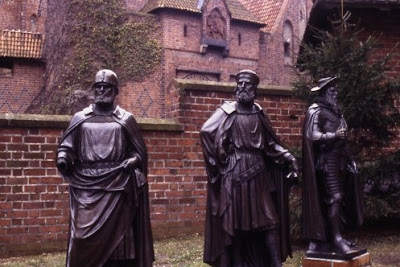
Teutonic Knights at Malbork Castle
Castle in Chorstyn
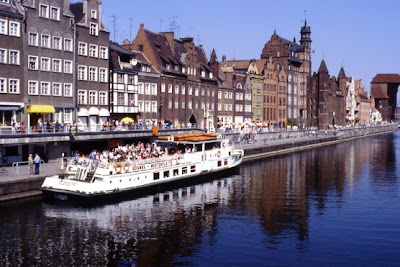
Waterfront in Gdansk

------------------------------------
Post created 13 Jan 2007
------------------------------------