Showing posts with label Aust-NZ. Show all posts

22 December 2016

Observations Down Under

I traveled to Australia and New Zealand from November 25 - December 16, 2016. Here are some of my general observations:

  • Kangaroos aren't everywhere.
  • Hard to tell Kangaroos from Wallabees.
  • What Koala bears?
  • Feral cats and goats are pests, also rabbits and opossums.
  • Mediocre food.
  • Nice school buses.
  • With the exception of towns, speed limit is the same (100 kph), regardless of whether it's a flat, straight road or a hilly, curvy one. 
  • No four lanes in New Zealand
  • Difficult place to drive: I got stopped for going too slow (New Zealand) and I got a speeding ticket mailed to me (from Australia).
  • Barns are for milking, shearing, and handling, not for housing livestock.
  • Dense stocking rates.
  • In some places:  sheep on the left and right, ahead and behind.
  • Dirty butts.
  • Dewormers are used by the truckload.
  • Obsession with free-range poultry.
  • Chinese, Chinese, and more Chinese 
  • Cafe's not restaurants.
  • Stuff closes early, by 5 p.m.
  • Romneys and Merinos.
  • Merino + Possum (clothing).
  • Lamb in stores and on menus.
  • Farmers are the same everywhere.
  • Agriculture faces the same challenges everywhere.
  • Coke, not Pepsi. 
  • Perception of Green.
  • Interested in American politics:  who did you vote for?


16 December 2016

International Antarctic Centre

The day before we flew home, we visited the International Antarctic Centre in Christchurch, New Zealand. It was located next to the airport, as was a hanger of the United States Antarctic Program. As an attraction, the International Antarctic Centre ranks high, as good as any museum I had (have) ever visited. It was full of information, simulations, and hands-on experiences, including a ride on an all-terrain amphibious Antarctic vehicle. It made me feel like I'd actually visited Antarctica.


Opened in 1992

Distances

All terrain vehicles

What's inside?

Course for all terrain vehicles

Here we go!

Blue Eyed Penguins (kororā) are New Zealand's smallest penguins and in decline, for various reasons. The Antarctic Centre operated a penguin rescue. There was an indoor and outdoor viewing area where you could see the little penguins and their antics.


Blue Eyed penguins

I bought the whole set of souvenir pictures they took of us. 


In front of an all terrain amphibious vehicle

Next to Emperor penguins in Antarctica

Look, Blue-Eyed Penguins!

In front a a US military aircraft (with skis)

According to AI, the US Antarctic Program hanger houses aircraft for the program.  The planes are owned by the  New York National Guard. The are large and ski-equipped. The US Antarctic Program was established in 1959 and operates three year-round research stations and two research vessels. Christchurch has been the US gateway to the Antarctic since the 1950's. It is only one of five cities with direct flights to Antarctica.


US Antarctic Program hanger

--------------------------------------
Post created 24 Sept 2026
--------------------------------------

15 December 2016

Products a plenty

One of the things I wanted to learn when I visited Australia and New Zealand was how they managed internal parasites (worms) in their flocks and herds. The part of Australia we visited (Northern Tablelands) was a region where the barber pole worm was problematic. Merinos were also prevalent to the region, and they are a very susceptible breed. In New Zealand, the parasites, which were plenty, were mostly the scour-type, non-barber pole worm. I had no doubt that one of the causes of the ubiquitous dirty butts was worms. Crutching seemed to be as common a management practice as deworming.


A lot of shelf space

Besides asking farmers questions about how they controlled worms, we visited some farms stores. What we saw was a "mountain" of drugs for treating internal parasites. Because the flocks are so large, the dewormers were sold mostly in large containers. Don't know what you'd do if you only had a handful of sheep (or goats). Perhaps, they'd measure out a few doses for you. 


Don't have either of these drugs

Product for a lot of animals

Besides there being plenty of dewormers on the shelves, they also had dewormers we didn't. They sold  Zolvix® and Startect®, the two "newest" dewormers, which have yet to make it to the US and probably never will. The farm stores also had combination drugs. A combination dewormer is one that has more than one drug active. It's now recommended to clinically-parasitized small ruminants be given combination treatments (more than 1 dewormer at the same time).


This is the one I want for my farm.

A lot of levamisole

Most of the combo drugs contained praziquantel, the drug specific to killing tapeworms. For a parasite that isn't supposed to be pathogenic (that's what all the research shows), there were plenty of treatment options. I wish we had a combo drug (in the US) that contained praziquantel. I would use it. Years ago, I purchased a two year supply of Firstmectin®, a combination of levamisole and praziquantel, in South Africa. I put it in my luggage. I have a unique situation with tapeworms on my farm. Tapeworms put my lambs at greater risk for enterotoxemia (and colic). I deworm all lambs at weaning for tapeworms. I use albendazole. I would prefer to use praziquantel.


Combo drugs

Yeah, tapeworms aren't a problem.

Barbervax®, the vaccine for barber pole worm, was also available for purchase in both countries. However, I got the impression that it wasn't commonly used. That made sense to me. The vaccine requires several doses, and the barber pole worm isn't the primary parasite on many farms. A few years (before Covid), the PERC committee of ASI was trying find a way to bring the vaccine to the US (Canada was interested, too). Don't know if there was every any follow-up or if Covid put Barbervax® permanently on the back burner.


Vaccine for CL + clostridial diseases

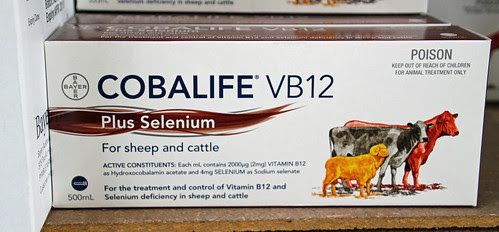
Some dewormers also contained minerals, such as selenium. You could also purchase paste products (gels) for treating and controlling mineral deficiencies or preventing diseases.


Zinc oxide capsules

Random shots Down Under

Everywhere I go, I take lots of pictures. Not all fit into specific blog posts, so here are some random pictures from my 3 week tour of Australia and New Zealand. 


We met at the Big Fruit in Cromwell
Sheep sheds in Tirau

We went horseback riding:   my horse Rio

Salmon farming in the High Country

Our lovely hosts in Tel Miro

Giant chess set at River Valley

Unloading fish in Napier

Don't think we could call a sports team ALL BLACKS

Giant chicken
Why so many egg choices?

French backpackers at Taylor's Run

Not a kangaroo, but a wallaby

14 December 2016

Sheep Research Down Under

We visited a university in each of the regions we went to during my sabbatical. In Australia, it was the University of New England in the Northern Tablelands.  On the North Island of New Zealand it was Massey University. It was Lincoln University on the South Island.

I didn't take any pictures at the University of New England (in Armidale). We met a few people, I recall. They showed us a few things on campus, but otherwise pawned us off onto Michael Taylor. I recall there was some confusion when I contacted the university about our visit. I was interested in sheep. They planned goat visits. We were already going to see plenty of goats in New Zealand. 


View from the top

Hill full of sheep

We met with several people at Massey University (in Palmerstown North). They took us to see the sheep, high up in the hills. There were wind turbines where the sheep were grazing. The views were amazing. Not surprisingly, it was very windy. I don't recall the research they were doing specifically. We also saw their research cattle (beef).


Sheared Romney ewes

Wind turbines
Hill grazing

At Lincoln University (near Christchurch), we were hosted by a researcher (Andrew Greer) who did a lot with parasites. I had read his work previously and have since contacted him with questions  He showed us the paddocks where they were doing their research trials. I appreciated the time he spend with us.


Romney lambs

Central laneway

Paddocks

Grazing lambs

Cows, too

While my sabbatical was a sheep and goat tour, we did see cattle, mostly in New Zealand. We saw both dairy and beef cattle. Dairy is New Zealand's largest export. It is mostly grass-based, but it seemed like feed lots on grass to me. Beef is also a big export product.


Sale Yard cattle
Pretty red cattle

University calf

Mixed species grazing
Cattle pasture on the North Island
Out to pasture