Showing posts with label Eastern Bloc. Show all posts

06 November 2024

World's Worst Car

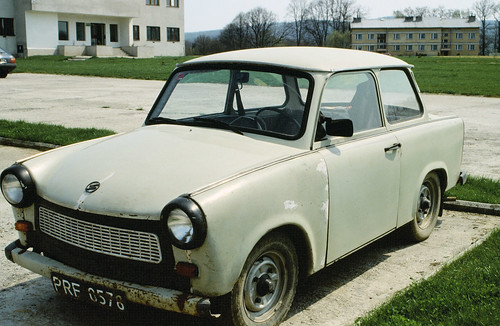
My early travels were to the Soviet Union and Easter Bloc. During these travels, I became fascinated with the cars made there; most notably the East German Trabant, the "worst car ever made!"


Trabant in Poland

The Trabant was a series of small cars produced from 1957 to 1991 by a state monopoly in East Germany. There were four models. Because materials couldn't be outsourced, the car was made from cheap materials. The car had only a two cylinder engine and created a lot of pollution. It didn't have any gauges on the dashboard or seatbelts in the backseats. Nonetheless, it was an East German status symbol during the Cold War. 


Trabant in Hungary

After the fall of the Berlin Wall, many East Germans drove to the West in their Trabants. After that, the car all but disappeared; the factory shut down. Nowadays, Trabants have a cult following, even in the US. According to the internet, there are still 25,000 of them still out on the road. There's a museum dedicated to the Trabant in Berlin. I would love to visit it.


What's worse than a Trabant?  Two Trabants

I saw Trabants in several different Eastern European countries, including Poland and Hungary. I rode in them a few times.

A D D E D

I had to add this picture to my Trabant post. A quirky painting of two sheep in a Trabant. The picture was being displayed in a restaurant in Vik, the southern most village of Iceland. I guess the Trabant is even legendary in Iceland.


Two sheep in a Trabant

01 January 2002

The Golden Arches

Thirty-five years ago, I started collecting McDonald's placemats.  I thought it was cool to see the placemats (and menus) in different languages, especially Cyrillic. So I began collecting placemats in the countries I visited, mostly Eastern Europe. I stopped collecting years ago, but held onto the original paper placemats and scanned them for this post. I consider them one of my most unusual collections.

Moscow (Russia)

The first McDonald's opened in Moscow in January 1990. It was a big deal, a symbol of  Western culture and capitalism and of the USSR's opening to the outside world (end of the Cold War). When I visited Moscow in 1990, we went to McDonald's on several occasions. We always encountered long lines. Police monitored the crowds; better not butt in line! Ironically, it was total chaos once you got inside the restaurant, as everyone rushed towards the counters to place their orders. The menu was similar, but quite expensive for the average Russian. The Moscow McDonald's was operated by a Canadian company. After Russia invaded the Ukraine in 2022, McDonald's ceased operations and withdrew from the country. 
Prague (Czech Republic)
Moldova
Poland

The first McDonald's was opened in Poland (in Warsaw) in 1992. I lived in Poland for six months in 1993. Every time we went to Warsaw (8 hours away), we ate at the McDonald's at least once. Pizza Hut was our first meal stop. At the time, I didn't like how they made pizza or burgers in Poland, so whenever we had a chance to eat the American staples, we did. Otherwise, the food in Poland was generally good.  


Germany

Mexico

In the 1990s, there were more McDonald's than any other restaurant in the world. In 2025, McDonald's was second behind a Chinese fast food restaurant. 

-------------------------------------
Post created 16 Jan 2026
-------------------------------------

01 October 2001

A forgotten country

August-September 2001 -- I did a Farmer-to-Farmer assignment with Citizens Network for Foreign Affairs (CNFA) in 2001 in Moldova. It was a solo assignment. I didn't know anyone before I got there. I taught farm financial management to farmers. I managed to get home a day or so before 9-11.


Orthodox Christianity is the most common religion.
My translator, driver, and everything else
Host family

Our car
First day of school

Moldova is one of the most interesting countries I have visited. It is an Eastern European country and former Soviet Republic. Moldova and Romania have a long and complicated relationship. They speak the same language, though I'm sure there are differences. Relatives were kept apart during the Soviet era. 

Village water supply
Moldovan church

Moldova was annexed by the USSR after WWII, while Romania remained under the sphere of Soviet influence. In 1991 when the Soviet Union dissolved, Moldova declared its independence. While Moldova has gradually transitioned to a market economy, its journey has been difficult, and it is the second poorest country in Europe. It is not a member of NATO or the EU, whereas Romania is. 


Vineyards

The local mill

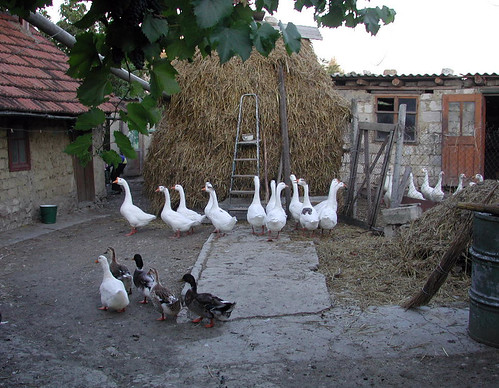
Why did the geese cross the road?

Horses were still being widely used.

Moldova has good black soils.

The climate in Moldova is ideal for agriculture. Soils are black and productive. Vineyards and orchards are common. The wine industry is a major economic sector. Moldova is a top 10 apple exporter. Sheep are a traditional enterprise in rural villages, but the industry is probably of little economic significance. When I visited in 2001, the sheep were mostly dairy. Geese were a popular site in the countryside and likely an important protein source for villagers.

Goose for dinner?

Free range grazing

School teacher and his son

Shopkeeper

Eastern Orthodox church

In 2001, Moldova was 10 years into a market economy, and their economy was still struggling. It was proving difficult to dismantle the system of state and collective farms forced upon them by Soviet collectivization. Many farms lay idle. Production lost. Stores had goods, but no one to buy them. In the rural villages, there wasn't a lot of indoor plumbing. A visit to the countryside was like a visit back in time. Moldovans had just voted the Communists back into power. Who could blame them? Freedom doesn't mean much when you don't have food on the table.

Dairy sheep in a fold

Moldovan countryside

Geese everywhere

Farm kids

Milking sheep

During the week, we (myself and translator) stayed in the villages with a host family. After a few days, we'd return to the capitol. In Chișinău I could get a hot shower, use a toilet, and eat at a restaurant. But it was in the villages that I got to meet people and learn about their past and hopes for the future. I recall meeting a school teacher in one of the villages. He had one of the few houses with indoor plumbing. He related his experiences teaching. He told us about the difficulties trying to connect with relatives in Romania during the Soviet era. While walking around the village, I remember meeting a woman who was thankful to the US for rescuing her daughter from white slavery. It made me free proud. I was somewhat of a novelty when I walked around the village.

Orhei-Vit (still in business)

Picture with important people


Moldovan currency is a Leu.

---------------------------------------
Posted created 29 June 2024
---------------------------------------
07 August 1993

Astrological Clock

Another thing Prague is known for is its clock. The Prague astronomical clock (Prague Orloj) is a medieval astronomical clock attached to the Old Town Hall. The clock was first installed in 1410, making it the third-oldest astronomical clock in the world and the oldest clock still in operation. The Astronomical clock show runs every hour sharp from 9 am until 11 pm. I have seen the show several times. 

Prague astronomical clock

Old Town Square

The clock has been repaired several times since it was installed in 1410. It was last renovated in 2018 for a cost of $2.6 million, many years after I saw it. The restoration created controversy because some people claim that the artwork on the dial was altered.


-------------------------------------- 
Post created 30 May 2026 
---------------------------------------

The Charles Bridge

The Charles Bridge (Karlův most) is one of Prague's most iconic landmarks. It is a medieval stone bridge first constructed in 1158. At one time it was the only bridge that crossed the Vltavia River. It connected the castle with Old Town. Now there are many bridge. There was usually a lot of activity on the bridge. Sadly, when Mom visited, the bridge was quiet. Only pedestrians. 


Charles Bridge (Karlův most)

1693 feet long x 33 feet wide
Performers on the bridge

--------------------------------------- 
Post created 30 May 2026 
---------------------------------------

Golden Lane

Golden Lane (Zlatá ulička) is a picturesque street situated in the Prague Castle complex. Originally built in the 16th century to house Rudolf II's castle guards, it takes its name from the goldsmiths that lived there in the 17th century. Golden Lane consists of small houses, painted in bright colors. 

Medieval houses

In front of one of the houses

The last residents of Golden Lane moved out in 1953. The houses are now souvenir shops. I don't recall buying anything, any of the times I visited.


From the other direction
Mom ducking

Fairy tale house

-------------------------------------
Post created 30 May 2026
-------------------------------------

Prague Castle

Across the Charles Bridge is the Prague Castle (complex or district). Prague Castle was built in the 9th century. It has long served as the seat of power for kings of Bohemia, Holy Roman emperors, and presidents of Czechoslovakia. According to the Guinness Book of Records, Prague Castle is the largest ancient castle in the world. We were fortunate to see the Changing of the Guard at the castle during one of our visits.


Guard gates
Prague Castle

    C H A N G I N G   O F   T H E   G U A R D

Here they come
Face off

Changing of the Guard

Goose-stepping soldiers

Prague Castle Guard (Hradní stráž)

----------------------------------------
   Post created 30 May 2026   
----------------------------------------